Translate

Showing posts with label India. Show all posts

Friday, December 12, 2014

Oh! those Russians.

Oil is threatening to go below the US$ 60 per barrel mark and there is a smile on the Saudi kingdom - why? Don't know. But then; instead of beaming a smile, why are the stock markets around the work sulking? Not sure. But;  could it be that the world is bracing itself for an economic catastrophe based on indications of negative or low growth? Each day, I hear a new story which contradicts the other on reasons explaining this global anomaly. I for one am quite unhappy. Not only has the falling Sensex shaved off some of my paper wealth but the falling rupee (now at 62+ to the USD) has made my holiday overseas a trifle more expensive. 

But if there is one person expressing a greater disgust than me on world events; then, it has to be President Putin of Russia. With economic sanctions preventing his Country from selling oil and gas to the west over the Ukraine crisis, the Russian Rouble seems to be playing “Russian Roulette” with itself shooting itself down to new lows with each passing day. 
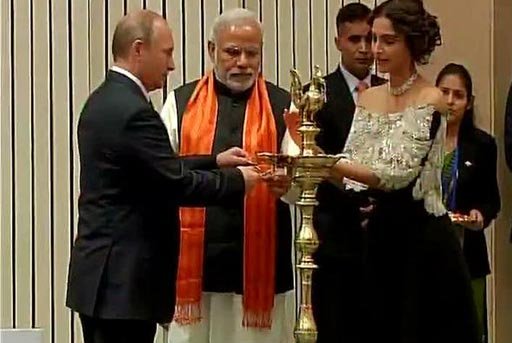
The West may not like them now; but Russians have been and are always welcome to India; even before the Russian ladies became desirable eye candy, and even though the strong brotherly equation that we once enjoyed with the former USSR block is all but gone. So; "Dobro pozhalovat' v Indiyu Prezidenta Putina" (welcome to India President Putin). India still believes that there is a lot that we can do together specially in the areas of technology, military and energy security as well as making many Indian women happy by getting direct access to a large source of good quality big sized diamonds at much cheaper rates than through the western run cartels.

Since it is clear that India is pretty much the big buyer; which suits Russia under the current economic situation; India will have to fork out a lot of its forex reserves to pay for its imports from Russia. Well; Russian goods are not necessarily the best in the world – and to pay top dollar with a weakening Rupee may not be such an attractive line to pursue. Then; what if we revive the Rupee-Rouble trade? The scope of trade is virtually unlimited. However, this system has been thoroughly abused by both sides based on the dollar arbitrage that could be extracted. The solution of course is to create a benchmarked trading currency that involves all the BRICS Countries as the trading problem faced by them all is the same. India would love to trade with China as well in a non dollar currency. The foundation of the BRICS bank itself is based on solving this situation so why wait? If the world can accept a Bitcoin then a BricsCoin too can become real.

While deals have been supposedly struck for purchase of crude; nuclear technology; joint weapons development; trading in diamonds and agri-goods; India will have to extract firm commitments from Russia to invest in Infrastructure over here for the whole package to be equitable on both sides. Our Prime Minister has been compared to Mr. Putin in many ways and he in turn has expressed his love for Russians in more than one way through his numerous tweets. The relationship suits both nations.  Will it then create a new tectonic shift in the Indo-US relations? On the surface - unlikely; but then Russia never expected such a hard western stand either. In my view this may just be the relief valve required to bring some calm in an anxious world where no one looses face.


With the Rupee heading towards 70 to a dollar and the Rouble racing up to nearly the same, my next summer holiday maybe spent exploring the beauties of Russia - only if the Russians can accept our humble Rupee as sweetly as the US Dollar. Oh! those Russians. 

Tuesday, November 25, 2014

Modi-nomics

Globally oil price is falling but US Dollar is rising;
net cost of oil import for India still the same.
The Indian Rupee is falling but gold imports are rising; 
keeping India's balance of payments in shame. 
If inflation is falling then why cost of essentials rising; 
somewhere there is a scam to tame. 
Production - exports falling but still stock markets are rising; 
higher and higher the indices aim.
Interest rates ain't falling but debt takers are rising;
its hard to understand this banking game.
Real estate ain't falling but unsold inventory is rising; 
on debt this industry stands lame. 
FDI ain't falling but infra investments not yet rising
despite the commitments from leaders that came. 
Are good days coming to see India shining; 
or will Modi-nomics equal bubble-nomics in name? 

Sunday, November 23, 2014

The callous end of INS Vikrant


INS Vikrant -

A historical summation of  its life of 71 years:


Keel Laid October 1943 in the UK - christened as HMS Hercules - Majestic Class Light Fleet Carrier.

Displacement - 20,000 tonnes. Built to fight in WWII; but was only 3/4th completed at the end of the war - so was never completed by nor served in the Royal Navy. Sold to India in 1957. Completed and commissioned as http://www.mumbaimirror.com/mumbai/cover-story/Ex-Navy-men-to-bring-Vikrant-back-to-life/articleshow/46857426.cmsINS VIKRANT in 1961. Served in the Indian Navy until 1997 (36 years) and was primarily responsible for India's naval victory with Pakistan in 1971. Received upgrades (1979 to 1982) to accommodate newer generation VTOL aircraft like the Sea Harriers. Converted to a naval maritime museum until 2004 and sent to the scrap heap sometime thereafter on account of no caretaker and no funds. Declared dead in November 2014 at a ship graveyard called "Darukhanna" where its carcass is now being cut for its high grade steel.  An unceremonious end to a celebrated metallic warrior of the Indian naval forces.


I think I was about twelve when I boarded this elegant and majestic warship. By today's standards, its about half the size of any aircraft carrier; but, back then - it was one of the largest ships in the Asian region. I was awestruck by what I saw, and within a few days of my visit was inspired to join the Sea Cadet Corps. wanting to become a naval pilot someday. I loved planes a tad more than ships and a career as a naval pilot was just perfect to satisfy my thirst for being a part of both the air and sea, It's a different story that life had written for me. I still claim to be a man in uniform; but I sport business attire and not battle fatigues; fly in commercial aircrafts instead of a fighter jet; and commandeer a fleet of hotels and not ships. But back to INS Vikrant; could we all have done something to protect this inspiration of mine from going the way it did?

The Navy will carry on the Vikrant legacy like any other navy in the world has - that is - by christening a successor ship with the same name.  India's own indigenous aircraft carrier has been named INS Vikrant and that will ensure that the name is not forgotten. But the history bound to the ship is lost. There have been calls by a political party in Maharashtra to construct a monument in the sea costing INR 2 billion or more honouring Chattrapati Shivaji (the first Maratha king). If a railway station, international airport and many landmark buildings have b
een named after him; surely the Maharashtra government could have purchased this ship at the value the scrap dealer paid (INR 630 million) and turned it into a fitting memorial that would have served both purposes. In fact the ship that was built to withstand the severity of the sea would not have needed environmental clearances either.

It is sad that politicians can commit billions of rupees to idolize their own ideologies and historical statements - on schemes that do nothing more than siphon off funds from actual public use to waste. This ship deserved a better fate being India's first carrier. In some other nations; the ship's steel would have been used to create miniature replicas of the vessel to be sold to those interested in getting their hands on a piece of this history. It certainly would have got the exchequer more than it received from the scrap dealer. This attitude also reflects how we treat our ex servicemen and why there are lesser and lesser recruits who voluntarily join the armed forces. If scams depriving pensions and assistance to the survivors of war heroes is taken into consideration - this callous end of INS Vikrant is a small matter in comparison.

Going back into my personal history of when I was a kid and fascinated by the armed forces, I  heard a song played by the naval band and still remember the lyrics  "Aisa desh kabhi na dekh - kabhi na suna hai.." (Never seen or heard of a Country like this - refering patriotically to India). I think, the words of this song lend a very different meaning to me today. Yes, I have never seen or heard of a nation that is so unpatriotic to its own protectors, may it be the men or women in uniform or the machines that serve them; specially when I take into account that this is the same Country that has a day reserved to worship work tools and weapons as gifts from God. I am sorry my inspiration that this is all that I could do to honor your memory and that of your valiant crew. "Jai Hind".

9th April 2015 : ’EX-NAVY MEN TO BRING VIKRANT ‘BACK TO LIFE


27th Dec 2015:
27th Jan 2016 Finally this is what happened:

INS Vikrant gets permanent memorial in Mumbai


Tuesday, November 18, 2014

Hotels - It's BUY BUY for some and BYE BYE for many

Flashback circa 2006 - GRI - New Delhi. I was working as a consultant to a Real Estate Fund back then advising it on the hospitality sector, and attended this event on its behalf. All I heard there was that every known and unknown developer attending the conference was going to build more hotels than the number of  fingers and toes he had combined in the next 4 to 5 years. Such scale of development had eluded the best of the best in the Indian hospitality industry until then. Each one of them was sold on the story that the whole of India has lesser number of rooms than Bangkok. India had some 90,000 hotel rooms (of which some 50,000 were branded) back then and needed to double its inventory real quick - that is by 2010. Then, I heard a sane voice from one of the attendees (who was leading Accor's initiative in India at that time) that the real number is closer to 500,000 when all forms of temporary accommodation were added up and doubling the inventory was not really the answer. But like all sane voices; it was drowned by the noise created by every hotel and property consultant ridiculing that claim.  The great gold rush in the Indian hospitality sector had begun. Projects were being conceived at unheard of land rates with occupancy, average daily rate and valuation assumptions to justify the financial viability to the numerous bankers and private equity players waiting to pour money in this game.

Yesterday; 18th Nov. 2014, I was invited to attend a seminar organized by a leading law firm on "Issues affecting Indian hospitality sector". Got to hear some interesting facts; some amused me and others that got me thinking on what's in store for this sector next. I learnt that the industry compounded annual growth; charted for the last 15 years tells us that demand and supply have kept pace evenly at about 11% with the demand a tad ahead of supply. Then, all hotels should be theoretically clocking at least 80% + occupancy; which is far from the truth. The same statistician rolled out more numbers that the first year performance for new hotel openings has progressively declined from 47% in 2009  to 35% now on account of supply pressures. Occupancy percentages overall for the last 5 years has been stagnant at about 58% and average room rates (ARR) have actually shrunk 3% or more depending on segment. The dark horse holding up the gloom seem to be the 2 star hotel segment that has seen ARRs climb 7.7% in last 5 years with occupancies averaging around 62%. To put all these numbers in a better perspective; India today has some 180,000 hotel rooms across all categories of which 100,000 are branded; and wait; the next couple of years will see the total number cross 250,000 rooms with at least 150,000 of them in the branded category. I am not sure if these totals include the temporary accommodation units as my take is that by year 2016 - India would have close to 1 million units servicing this type of stay need.

As of today, the situation looks more than terrible. Travel around the country and one will see several hotel skeletons doting every city; as much as those of residential and commercial buildings. It's easy to understand why this situation is staring at our face. The nation has gone from a rising to a falling star status in the last 10 years as has its currency. Global economies have not done much better either. Unplanned developments with very little thought, study and planning fanned by developer egos and easy finance from all kinds of investors and lenders has not helped the cause either. From a hotel perspective, the only places that have a smile to show are Mumbai, Delhi (not NCR), Goa and kolkatta. Rest of the Country has over supply written all over it. Pune and Bangalore are inching back to survival from an occupancy but not a rate perspective. Thankfully, India's natural inefficiency in delivering project completion on time has saved the industry from a situation that could have been much worse than it is now. Despite all the technological developments in the construction sector; India still requires an average 29 months to deliver an affordable hotel at a cost of between 24 lakhs to 40 lakhs a room (without land) whereas the same hotel could be built in less than 14 months at the same cost per room inclusive of land. With occupancy and rates continuing to remain the way they are for the next couple of years, most hotels will find it very hard to justify their viability to money backing them. It is certainly going to be a time when a lot of owners holding completed and incomplete assets are going to check-out saying Bye Bye to this industry.

Yet, before the industry decides to cry tears of blood in unison; there is not only a glimmer of hope but a fantastic opportunity waiting out there. Hotel industry usually trails the spurt in economy by about 8 quarters and that means that by 2017-18 the industry should start correcting upward. Anyone committed to this sector and sitting on cash is in a driving position to acquire quality finished and unfinished assets. Specialization in hospitality, along with efficiency in executing projects, managing operations and a strong marketing backbone are keys to winning this game. While I doubt if the Indian REIT structure in its current context will help this sector; hotels being classified as infrastructure can certainly benefit from InvITs (Infrastructure Investment Trusts). Further, the entire lending industry is ready for a reshape and it is not impossible now to get financial institutions to commit longer duration money with repayment programs tailored to the health of the asset - as well as take a more rational approach to security and collateral. I am already hearing the call of Buy Buy getting louder on this street called the "hospitality world".

Pain is good - and like it signals healing in our body - it's also a sign of healing in the industry. Everyone has learnt lessons in the last few years. No longer are hotel brands and operators (new or old) spoiling the developers by offering them ridiculously high fixed leases or making investments in shells that the former do not own or control. Leases and investments are increasingly linked with performance and secured by contracts that make operators virtual owners of the property. Developers have understood that hotels are not the classic real estate business with a build-sell-value formula. Building hotels requires sustainable quality which they don't care for when making inventory to sell; and running hotels needs micro attention which can sap a lot of time from their super profitable construction business - which means finding operators to run their properties. Hiring an operator is not the same as hiring a contractor as developers have learnt and getting away with under performance is now increasing unacceptable as operators have learnt. Recognizing "Prefered Owner Returns"; subordination of fees to debt service; linking fees to operating results are increasingly making life difficult for international brands to conclude business in India and better for domestic operators who understand these issues well - and are ready to commit money if need be to ensure the health of the hotel they put their name on. The best is that most developers are now understanding that the land pricing for and yields from hotels are just not the same as commercial or residential or retail. But, the long term value that wellrun hotels command are unmatched by other spaces they build - and that's driving committed developers into this segment; ones who understand that the pain experienced in the first few years is more than made up by the gain that hotels deliver thereafter.


Tuesday, November 11, 2014

Make in India

I don't know if anyone can remember; but there was a time when Japan was laughed upon for its manufacturing abilities. It's hard to even find articles on the net referring to that period when Japan was notorious for cheap, badly made knock offs of almost everything under the sun from cars to cameras. Over time Japanese pride changed the image and soon "Made in Japan" stood out as a brand in itself. It overtook the world in technology and in the World War of economics; almost took over the entire world. Many smaller nation like Korea, Malaysia, Thailand and Taiwan tried to imitate the Japanese model but with limited success. China is probably the only nation that has succeeded in a variation of what the Japanese did by cloning and owning (as its own) ideas rather than coming up with path breaking new ideas. In time that too may change as is the fact that "Made in China" though not a brand in itself - is now a given for the entire manufacturing spectrum from bad to the best for everything made in the world.

India on the other hand; despite having a relatively freer economy as compared to the Chinese some 30 years back - lost out in the race to become a world manufacturing hub despite its so called low cost labour advantage. I have tried to search for answers and have come up with a conclusion (right or wrong) that India's failure stems from a lack of belief in the concept called "national pride". We are Maharashtrians or Punjabis or Tamil or Gujarati first - Indian second. Somehow; years of foreign rule has brainwashed us that "imported" is better and that has kind of become a self fulfilling prophecy. It's a different matter that the manufacturing policy is based on a system of entry-exit and operational hurdles that is the biggest put off for manufacturing anything in this Country; but those who do know how to bend the system and thrive in an environment that encourages evasion, cheating, sub standard and inconsistent quality among a list of several negatives. In general; being mediocre is fine - produce now and refine later is the manufacturing mantra - knowing well that the demand is limitless for the scarce goods produced as a result of which the consumer will lap up anything without recourse the very limited consumer protection systems in place.

The malaise is so contagious that even foreign brands that have set up shop in India are now getting used to accepting quality defects in their famed zero tolerance production lines as a part of life here. Consumers too for some reason have no will to complain about shoddy service or products being dished to them. Too busy to make the effort or too low down in the pecking order to be taken notice of.

Will a change of laws alone bring about a change in the Indian manufacturing context? Laws have no effect on the level of corruption in this nation and I am not referring to monetary corruption alone. Increase in productivity, management and labour attitude, adherence to quality standards, ethics, and a host of other measurable intangibles have to kick in to make "Make in India" a success. India does not lack in innovation or entrepreneurship - there are plenty of examples to substantiate it - right from our "Mission to Mars" to the several "Rags to Riches" heros. All we need to "Make ourselves in India" first and before you know it several Indian brands will be a household feature across the globe.

Friday, October 10, 2014

War Peace and Haider

While the Indian and Pakistani troops were shelling each other's borders in the Kashmir region last evening (9th Oct); I was busy watching "Haider" - a film by one of my favourite movie makers Vishal Bharadwaj. It's a screen adaptation of Shakespeare's "Hamlet" that's been very well melded into the strife of the Kashmiri disturbance in the 90's, to set up the Indianized plot and characters. I am not about to write this film's critique barring that each actor played his or her role to near perfection - with the moral of the story coming out quite clear that revenge begets revenge and not a closure to anyone's pain. I think the leaders on both sides of the border should pay heed to this as the only people getting brutally affected by the events on the border are innocent citizens.


I must praise the openness of my own Nation's people for the screening of this movie, as it has shown the excesses of the armed forces in trying to control a situation. Pretty sure that a movie like this would have been banned in Pakistan had a Muslim film director made it showing excesses by the Pakistani army against its own people in the NWFP and Baluchistan. The Indian armed forces too have taken a pragmatic approach in not censoring it, given the artistic license that a filmmaker has to tell his story as he interprets it. There were no demonstrations on the street either in Kashmir or any other State in India protesting on how various Indian communities were portrayed. In fact people have praised the movie on all counts.

Unfortunately, the army (armed forces)  does not receive praise that it deserves unless it fights an external battle. Unlike the police that battles internal elements on a daily basis, the army knows only friend or foe and when it is instructed that it's own are foes - it does not discriminate in its dealing with them. It is this same unidirectional machinery that unquestioningly puts every resource it has at its disposal including lives of its soldiers at stake in dangerous conditions that challenge even the might of nature to rescue and rehabilitate its own people - and many a times even those that throw stones and abuses at it. The army is not known to betray its own - it only follows orders.

But; Haider is a story of betrayal by his own and the exaggerated disgust that he felt by the same - enough for him to take harsh steps of reprisal. I think the trouble on the border is being attributed to the internal problems that the Pakistanis are facing with their own system and rulers and the situation with India has been "created" by the latter to divert attention. But politically, India is not too far behind Pakistan in this sentiment; even though the reasons may be some what different. The way Indian politicians have betrayed the trust of their own people - time is not too far when India may look like the streets of Paris in the French revolution. I hope I am as good in my prediction as Rev. Malthus was in economics.


Ironical as it may be - when the two nations are fighting a quasi WAR; it was fab to hear (this morning 10th Oct.) that the Nobel PEACE Prize 2014 was being shared by a deserving Pakistani and an Indian - Ms. Malala Yousafzai and Kailash Satyarthi.

http://time.com/3489223/malala-yousafzai-and-kailash-satyarthi-win-nobel-peace-prize/